On this page
- The short version
- Also found
- How I did it
- 01YouTube is in most Google AI Overviews for how-to questions
- 02When Google links to a second, it quotes what is said there
- 03The cited second is early
- 04The cited moment, next to the rest of the same video
- 05Cited videos are smaller and newer than the videos YouTube ranks
- 06Shorts get cited, and the citations hold
- 07At the cited second, more lead-ins and fewer answers than nearby
- 08The AI Overview's own text does not copy the video
- 09The videos on the rest of Google's page
- What I would test
- Limits
- Data
- Cite this study
- About the author
When I searched Google for how to freeze a row in Google Sheets, the AI Overview cited YouTube videos in every run. For how to hard cook eggs, some of its links went to an exact second inside the video. Across the questions in this study, most Google AI Overviews cited YouTube. I wanted to know which moment Google picks and what the creator was saying there. So I searched Google with 600 how-to questions, three times each, pulled every YouTube video the AI Overviews cited, and read the captions at the cited second.
The short version
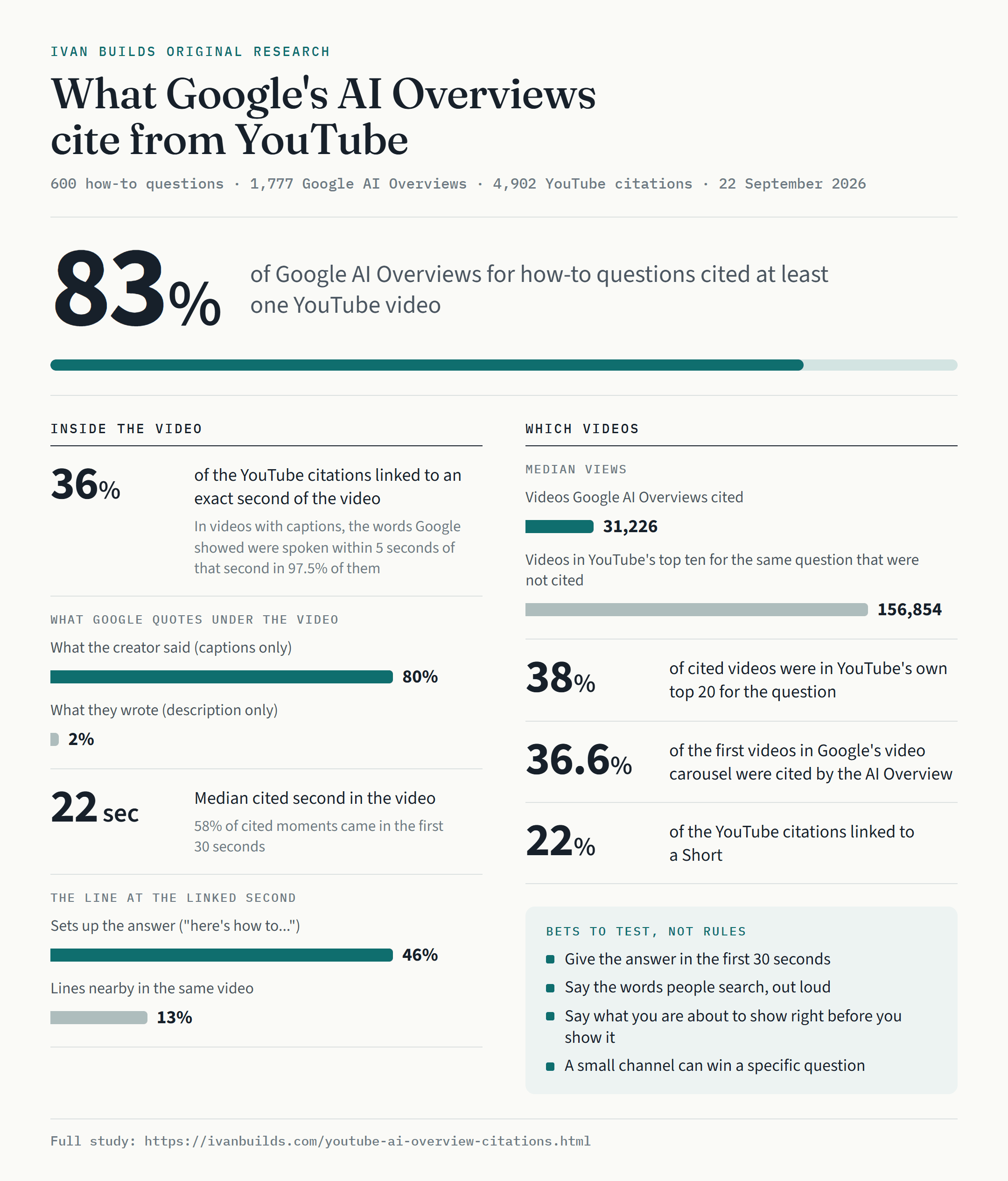
83% of the Google AI Overviews in this study cited at least one YouTube video, 1,460 different videos in all, and 36% of the YouTube citations in them linked to an exact second of the video.
A snapshot shows what Google's AI Overviews cite, not what changes it, so the points below are bets to test, not rules. Under each one are the numbers behind it and the finding they come from. The full version, with the strongest objection to each bet, is in What I would test.
- BetGive the answer in the first 30 seconds.Evidence in Finding 3:
- The median cited moment came 22 seconds into the video, 7% of the way through it.
- 58% of the cited moments came in the first 30 seconds.
- BetSay the words people search, out loud.Evidence in Finding 2 and Finding 4:
- The words Google showed under a cited video matched only its captions (what the creator said) in 80% of the YouTube citations, and only its description in 2%.
- When Google linked to a second of a video with captions, the words it showed were spoken within 5 seconds of that second in 97.5% of those citations.
- In 154 of the 230 videos I could compare, the cited moment carried more of the question's words than the rest of the same video: 44% of them on average, against 31%.
- BetSay what you are about to show, right before you show it.Evidence in Finding 7:
- An AI model sorted the line at each cited second, and at seconds nearby in the same video, without knowing which was which. The cited line set up the answer (named the task or said what comes next) 46% of the time, against 13% for the seconds around it.
- BetA small channel can be cited for a specific question.Evidence in Finding 5:
- Question by question, the cited videos had fewer views on average than the uncited videos in YouTube's top ten for the same question, in 408 of 506 questions.
- The median cited video had 31,226 views and came from a channel with 83,200 subscribers, against 156,854 views and 164,000 subscribers for those videos.
- Only 38% of the videos cited for a question were in YouTube's own top 20 for it.

Also found
- Shorts get cited. 22% of the YouTube citations in Google AI Overviews linked to a YouTube Short (Finding 6).
- The citations hold from run to run. 78% of the question and video pairs cited in Google AI Overviews were cited in all three runs, and 75% of the question, video and second combinations came back on the same second in all three runs (Finding 6).
- The AI Overview's own text does not copy the video. Leaving out the question's words, it shared 28% of the cited moment's words, against 26% of the rest of the same video (Finding 8).
- Google's own video carousel points to the cited videos. Google showed a video carousel on 84% of the results pages with an AI Overview, and the AI Overview cited 36.6% of the videos in the carousel's first position (Finding 9).
How I did it
- The questions 600 real US Google searches, 50 in each of 12 topics: Excel, Google Sheets, Google Docs and Word, Google Slides and PowerPoint, iPhone, Windows 11, cooking, home repair, cleaning, gardening, exercise and personal finance. Each is phrased as a question and has at least 100 US searches a month. They were drawn at random from keyword suggestions after removing near-duplicates and off-topic searches a seed word pulled in (a car rental company called Budget, for example). No marketing or SEO questions.
- Google I searched each question on Google three times, an hour apart, in English from the US on desktop, and recorded the AI Overview and every source it cited.
- YouTube I searched YouTube once for each question on the same day. For every video an AI Overview cited, and every video in the top ten of YouTube's results for a question whose AI Overviews cited a video, I collected the video's details: views, channel subscribers, upload date, length, chapters and captions. For every cited video, I collected its English captions.
- The cited moment When Google links to a second of a video, the cited moment is the captions from five seconds before that second to twenty seconds after it. The video's other stretches of the same length, where Google did not link, are its other windows.
- The searcher's words The words of the question, leaving out small words such as "how" and "to". For a moment or a title, I counted the share of those words it holds.
- The rest of the Google page Each results page with an AI Overview also records Google's other blocks: the video carousel, the row of Shorts, the ordinary results and the perspectives block. I noted every YouTube video in them and its position.
- Seconds to compare For every cited second in a video with captions, I drew three random seconds from the same video within a minute of it, at least ten seconds from any cited second. The words showing at each of those seconds are its line.
- Line types An AI model read each line together with the questions whose AI Overviews cited the video, without knowing whether the second was cited, and sorted it: it gives the answer (a step, setting, fact or quantity), it sets the answer up (names the task, says what comes next or greets the viewer), or something else.
- The AI Overview's own words I compared the text of each AI Overview with the captions of the videos it linked to a second of, leaving out the question's words.
Finding 01YouTube is in most Google AI Overviews for how-to questions
Google showed an AI Overview for 99% of the 1,800 searches. Of those Google AI Overviews, 83% cited at least one YouTube video (95% confidence interval: 80% to 86%), and 4% cited no source at all.
By topic, the share of Google AI Overviews that cited YouTube was lowest for personal finance (65.1%) and Google Sheets (67.1%), and highest for home repair (95.7%), Excel (95.2%) and gardening (94.6%).
82.3% of the questions were how-to questions, 10.5% started with what or which, 4.3% asked how long, how much or how often, and 2.8% were something else, such as why or when questions.
The share of Google AI Overviews that cited YouTube was 86% for how-to questions, 67% for what or which questions and 67% for how long, how much or how often questions. For the 50 AI Overviews on other questions it was 90%, a small group.
Finding 02When Google links to a second, it quotes what is said there
36% of the 4,902 YouTube citations in Google AI Overviews linked to an exact second. Where the video had English captions, the words Google showed under the video were spoken within five seconds of that second in 97.5% of those citations. A second reader checked 60 cited seconds against the transcript without seeing the matcher's answers, with the matcher's misses oversampled. The matcher's precision was 97.5% and its weighted recall 99.6%, and it placed the start of the passage within three seconds of the reader in all 39 passages both found. The reader was a separate AI model (Claude), not a person.
Across all the YouTube citations, with or without a second, the words Google showed matched the captions alone in 80% of them, the captions and the description in 5%, and the description alone in 2%. Another 6.4% quoted a video's opening line, which the caption data lacks (see the limits below). Google's AI Overviews quoted what creators said far more often than what they wrote.
4% of the YouTube citations matched neither the captions nor the description. I asked an AI model to sort those by where the words came from, and a second reader agreed with it on only 32 of 60, so I do not use its labels. Every snippet they disagreed on read like the creator talking to the camera, in words my caption data did not have.
Where Google's quoted words were found near the linked second, I measured where they start relative to it. The median was -0.24 seconds, and the middle half of links fell between -1.08 and 0.28 (a negative number means the words start just before the linked second).
Links to an exact second were most common in gardening (58% of the YouTube citations) and personal finance (52%), and least common in Google Sheets (21%) and cooking (23%).
Finding 03The cited second is early
The median cited moment came 22 seconds into the video, and three in four came by second 59. Measured against the length of the video, the median cited moment sat 7% of the way through. 58% of the 558 cited moments came in the first thirty seconds.
Finding 04The cited moment, next to the rest of the same video
For each video with a cited moment, I compared that moment with the video's other windows. The caption data often misses a video's opening line, so I left out every window that starts in the first twenty-five seconds, on both sides. That leaves out the cited moments in the opening: this comparison covers the 230 videos whose cited moment came later. Each video counts once.
- The searcher's words. The cited moment held 44% of the question's words on average, against 31% for the other windows. It held more of them in 154 of the videos and fewer in 71.
- A chapter. A chapter from the video's description started inside 27% of the cited moments, against 12% of the other windows.
- An answer. An AI model read each window without knowing which one was cited, and judged whether it answered the question. In the 230 videos, it judged 89% of the cited moments to answer the question, against 82% of the other windows. A second reader labelled 100 of these moments, drawn at random, without seeing the model's labels. Weighted to all 5,087 labels, the model agreed with it 92% of the time (95% range 81% to 97%), so treat these two shares as approximate. The reader was a separate AI model (Claude), not a person. A first version of the model's instructions fell just short of the 90% this check requires, because it counted only complete answers; the figures here come from the second version, checked on a fresh sample.
- An announcement. A line that says what the video will show, such as "in this video" or "let me show you", was in 9% of the cited moments and 2% of the other windows.
- Words a second. The cited moments had more words in them: 3.22 words a second, against 2.99 for the other windows. They had more in 156 of the videos and fewer in 73.
- Numbers. A number was said in 23% of the cited moments and 23% of the other windows.
Finding 05Cited videos are smaller and newer than the videos YouTube ranks
For every question whose AI Overviews cited a video, I compared the cited videos with the videos in the top ten of YouTube's results for the same question that the AI Overviews did not cite. A video cited for two questions counts once for each.
- Views. The median cited video had 31,226 views, against 156,854 for YouTube's top results. Question by question, the cited videos had fewer views on average in 408 of 506 questions. Leaving Shorts out on both sides, they had fewer views in 379 of 475 questions.
- Channel size. The median cited video came from a channel with 83,200 subscribers, against 164,000 for YouTube's top results.
- Age. The median cited video was 589 days old when I collected it, against 1,272 days. Question by question, the cited videos were newer on average in 445 of 506 questions, and in 401 of 475 with Shorts left out. 16% of the cited videos were under six months old, against 5% of YouTube's top results, and 10% were over five years old, against 34%.
- Length. 18% of the cited videos were a minute long or less, against 9% of YouTube's top results. Between one and three minutes the shares were close: 33% against 34%.
- Likes. The median cited video had 0.8% as many likes as views, against 0.9% for YouTube's top results, and question by question the cited videos had fewer likes per view on average in 306 of 506 questions.
- Titles. The median title held 67% of the question's words for the cited videos and 67% for YouTube's top results. Question by question, the cited titles held more of them in 242 of 506 questions and fewer in 198.
- Chapters and captions. 25% of the cited videos had chapters, against 23% of YouTube's top results, and 20% had English captions that were not auto-generated, against 22%.
- YouTube's own ranking. Only 38% of the videos cited for a question appeared anywhere in the first twenty results of the YouTube search for it.
- Channels. The 4,902 YouTube citations went to 918 channels, and half of them went to 161 of those channels.
Finding 06Shorts get cited, and the citations hold
22% of the YouTube citations in Google AI Overviews linked to a YouTube Short. I do not compare that with YouTube's search results, which listed almost no Shorts on desktop: 0.5% of the top YouTube results I compared were Shorts.
I ran every Google search three times, an hour apart. 78% of the question and video pairs cited in Google AI Overviews were cited in all three runs, and for the median question the set of videos Google AI Overviews cited did not change from one run to the next (median Jaccard overlap 1.00).
The second held too: 75% of the question, video and second combinations Google AI Overviews linked to came back in all three runs, nearly as many as for the videos themselves.
Finding 07At the cited second, more lead-ins and fewer answers than nearby
At the cited seconds, 50% of the lines gave the answer, 45% set it up and 5% were something else. Set against the seconds around them in the same 542 videos, the cited second set up the answer 46% of the time against 13%, and gave it 49% of the time against 80%. The lines around a cited second were mostly the answer itself; the cited line was more often the one that leads into it. A second reader sorted 100 of these lines, drawn at random from each of the model's three labels, without seeing the model's labels. Weighted to all 2,213 lines, the model agreed with it 95% of the time (95% range 82% to 99%). The reader was a separate AI model (Claude), not a person.
Chapters did not mark the second. 32% of the cited seconds were in videos with chapters. In those videos, a chapter other than the opening one started within two seconds of the cited second 10% of the time, against 10% for the random seconds near it. Finding 4 shows a chapter starting inside the cited moment more often than inside the rest of the video; the link itself is not placed on the chapter's timestamp.
Finding 08The AI Overview's own text does not copy the video
Finding 2 shows that the snippet under a cited video is the creator's own words. The AI Overview's answer is another matter. Leaving out the question's words, the AI Overviews shared 28% of the cited moment's words, against 26% of the words in the other stretches of the same video (230 videos; the opening left out, as in Finding 4). A run of six of the creator's words in a row appeared for 2.6% of the cited moments and 1.4% of the other stretches. The AI Overview writes its own answer; the words it shares with a video are about as likely to come from anywhere in it as from the moment it links to.
Finding 09The videos on the rest of Google's page
Google showed a video carousel on 84% of the results pages with an AI Overview, and a row of Shorts on 32% of them.
46% of the YouTube citations in Google AI Overviews went to a video that also appeared elsewhere on the same results page: in the video carousel for 33%, the row of Shorts for 10% and the ordinary results for 7%. Set against YouTube's own ranking, 21% of the YouTube citations went to a video that was both on the Google page and in YouTube's first twenty results for the question, 25% only on the Google page, 18% only in YouTube's first twenty, and 36% in neither.
Seen from the carousel's side, the AI Overview cited 31% of the YouTube videos in it: 36.6% of those in the first position, 30.8% in the second, 27.9% in the third and 27.6% in the fourth. It cited 16% of the YouTube videos in the row of Shorts and 26.6% of the YouTube videos among the ordinary results.
What I would test
A snapshot shows what Google's AI Overviews cite, not what changes it, so each point below is something to test rather than a rule. The citations hold from run to run, so rerunning the same questions each month is a fair way to test them.
Test whether answering early goes with being cited. 58% of the moments Google AI Overviews cited came in the first thirty seconds of the video. The bet is that a video which gives its answer in the first thirty seconds is easier for Google to link to; a monthly rerun would show whether newly cited videos keep the pattern.
Test whether saying the searcher's words where you answer goes with being cited. In 154 of 230 videos, the moment Google AI Overviews cited carried more of the question's words than the rest of the same video. The bet is that the words people type, spoken at the answer, are what Google matches; the monthly rerun would check whether it holds for new citations.
Test whether a chapter at the answer goes with being cited. A chapter started inside 27% of the moments Google AI Overviews cited, against 12% of the other windows of the same videos, while cited videos were no more likely to have chapters than YouTube's top results. The bet is on where the chapter starts, not on having chapters, and it needs repeated runs after the change. Finding 7 adds that the linked second itself was no closer to a chapter start than the seconds around it, so the bet is a chapter near the answer, not a link landing on the chapter mark.
Test whether a small channel can be cited for a specific question. Question by question, the videos Google AI Overviews cited had fewer views on average than YouTube's top results for the same question in 408 of 506 questions. The bet for a small channel is a video that answers one question directly, measured in the next run. Cited videos were also newer: 16% were under six months old, against 5% of YouTube's top results, so a recent video on a common question is part of the same bet.
Test whether a clear line that sets up the answer goes with being linked to. The line at the cited second set up the answer 46% of the time, against 13% for the seconds around it. The bet is that a video which says plainly what it is about to show, right before it shows it ("to freeze a row, open the View menu"), gives Google a clean place to link. A rerun of the same questions would show whether newly cited videos keep the pattern.
Test whether a place in Google's video carousel goes with being cited. The AI Overview cited 36.6% of the videos in the carousel's first position. The bet is that the videos Google shows in its own carousel are the ones its AI Overview reaches for; checking a video's carousel position in the next run would test it.
What this study does not show
The questions are real US searches, but they are a panel of 12 how-to topics I chose, searched in English from the US on desktop on 22 September 2026, with one YouTube search per question. Other topics, countries, devices and days can differ, and Google's AI Mode was not part of it.
The transcripts are YouTube's captions as my collection returned them. For some videos the caption data starts a line late and misses the opening: 10% of the YouTube citations without a second, in videos with captions, quoted words from a video's opening that the caption data lacks. That is why Finding 4 leaves out every video's first twenty-five seconds. One video's details never came back from the collection queue. It is in two of the question and video pairs in Finding 5, as one of YouTube's top results; the chapter and caption shares count it as having neither, and the other comparisons leave it out.
Some choices were made after the data came in, and I list them here. I added the share of YouTube links that go to a Short when the planned comparison with YouTube's results turned out not to be fair: YouTube's desktop results list almost no Shorts. I added the caption-gap figure above, and the decision to leave the opening out of Finding 4, when I found the gap. I added the comparisons without Shorts in Finding 5 after reading the first figures. And I accepted the AI model's supporting quotes when they fixed caption errors, as long as most of their words appear in the captions in order; the exact check was dropping the corrected quotes.
Findings 7 to 9, the question types in Finding 1, the link timing and topics in Finding 2, the length, likes, channels and age bands in Finding 5 and the same-second figure in Finding 6 were added on the day this page was first published, from the same data. I wrote down how each would be measured before computing any of them; the one figure seen before that was a quick count of the cited videos found elsewhere on the Google page.
Three steps were done by machines and checked on samples: the matching of Google's words to the captions (Finding 2), an AI model's judgement of whether a moment answers the question (Finding 4), and its sorting of the line at each second (Finding 7). The second readers who checked them were also AI models, not people.
The line comparison uses seconds drawn within a minute of each cited second, so it compares the cited line with its neighbours, not with the whole video. The comparison of the AI Overview's text with the video counts shared words, not shared meaning: an AI Overview can say the same thing as the video in other words. The blocks on each Google results page are as my collection recorded them on the day; a searcher elsewhere, or on another day, can see a different carousel.
Nothing here is causal. I measured what Google's AI Overviews cited for a fixed panel of questions on one day. Whether moving an answer earlier, adding a chapter or saying the searcher's words changes what Google cites is a question for an experiment, not a snapshot.
Data
I ran 1,800 Google searches and recorded their AI Overviews: 600 questions, three times each, on 22 September 2026, plus one YouTube search for each question. Google produced 1,777 AI Overviews, which made 4,902 YouTube citations of 1,460 different videos. 558 cited moments had captions to read. The video carousels on those pages showed YouTube videos 4,956 times, and 557 cited seconds and the seconds around them had their lines sorted.
Cite this study
Ivan Smiljkovic (2026). 83% of Google AI Overviews for How-To Questions Cite a YouTube Video (Study of 1,777 AI Overviews). Ivan Builds. https://ivanbuilds.com/youtube-ai-overview-citations.html
Every section has its own link: hover a heading and use the # to copy it.
Embed the infographic
Free to use on your site with a link back to the study.
About the author
I study how Google and AI assistants choose what to cite, using public data I collect myself, and I publish the method and limits with every study.